Basics
A quick dictionary, from the very basics up. Tap a term to open it — if you already know it, leave it closed and keep your eyes on the talk.
Start here — the absolute basics
Cell
The basic building block of every living thing. Your body is made of trillions of them, and each cell keeps its own full copy of your DNA.
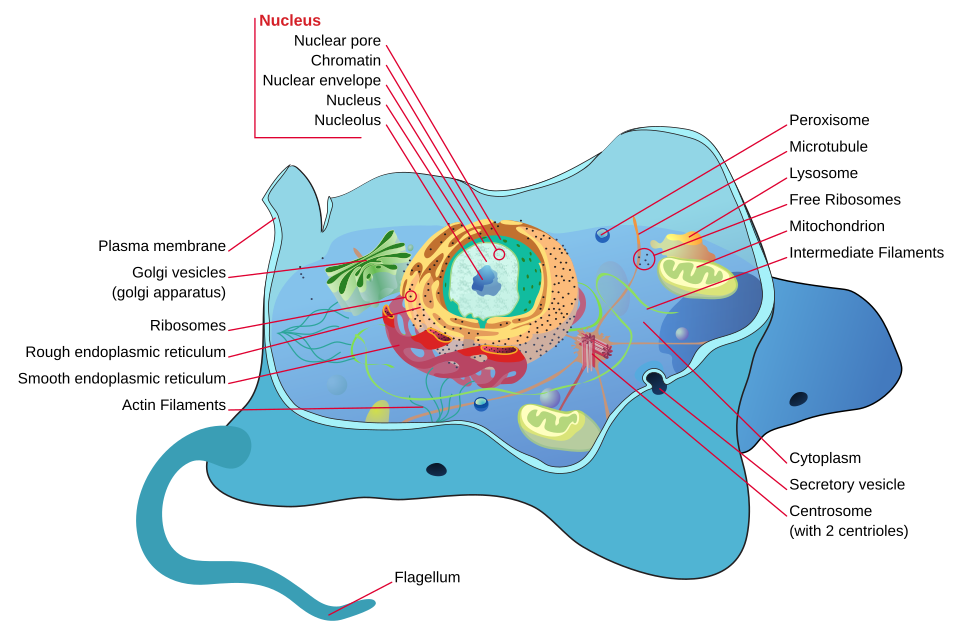
Diagram: LadyofHats (Mariana Ruiz), public domain — Wikimedia Commons
DNA
The molecule that stores life's instructions, written as a long string of chemical "letters". The exact order of the letters is the information.
DNA bases — the letters A, C, G, T
DNA is spelled with just four letters, called bases: A, C, G, T (short for adenine, cytosine, guanine, thymine). Their order along the strand is the message — like letters spelling words.
DNA has two strands that pair up (A always with T, C always with G), which is how it gets copied. A copying slip that sticks is a mutation.
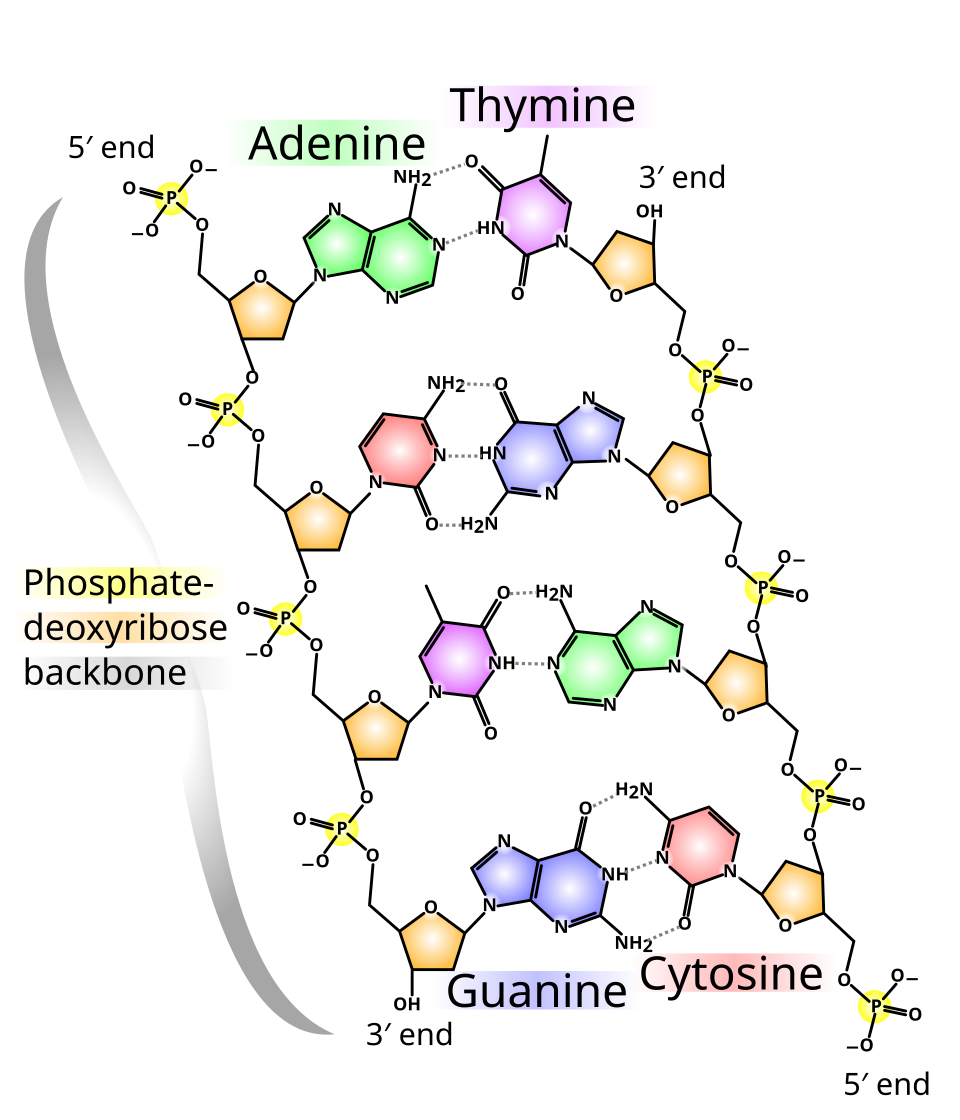
Diagram: Madeleine Price Ball (Madprime), CC BY-SA 3.0 — Wikimedia Commons
Gene
A stretch of DNA that spells out one instruction — usually the recipe for a protein that does a job in the body.
Genome
The complete set of an organism's DNA — every letter, all the genes plus everything in between.
Junk / non-coding DNA
The long stretches between and inside genes that don't spell a protein. Most of your genome (about 98%) is non-coding; a lot of it has no known job — the "junk" — though some of it works as switches that turn genes on and off.
Where your DNA lives
Where is DNA kept? (a cell)
One cell holds one nucleus and many mitochondria — and each of those two places keeps its own separate DNA. (See the labelled cell diagram under Cell, above.)
▶ Video from the talk: the two sets of DNA (Frith Lab)
Nucleus
The control room at the centre of the cell. It stores the big set of DNA — your nuclear DNA.
Nuclear DNA
The big set of DNA kept in the nucleus. It holds almost all of your genes — about 3.2 billion letters, packaged into 46 chromosomes.
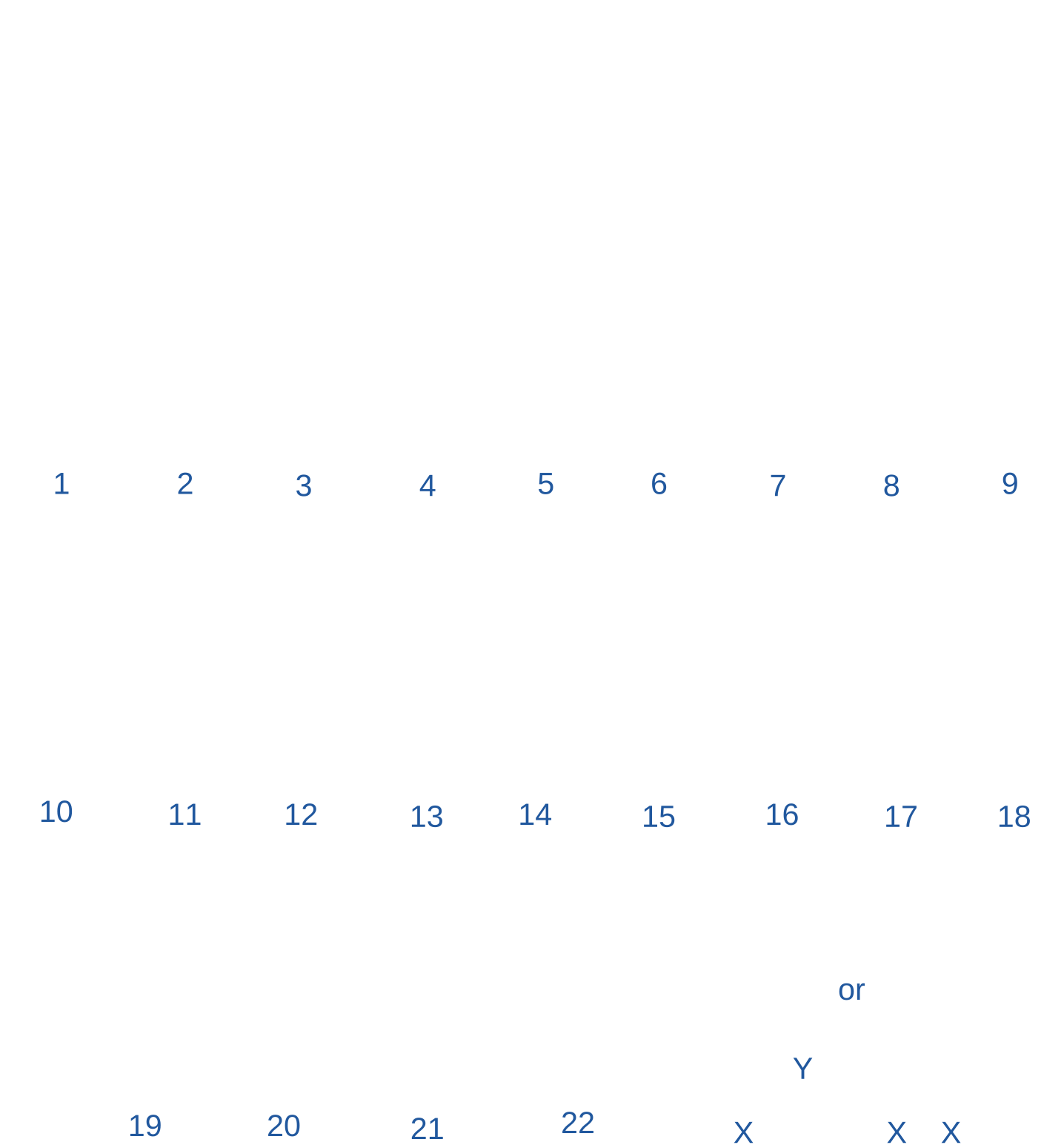
Those ~3.2 billion letters are bundled into 46 chromosomes (23 pairs) — the big set, in packages.
Diagram: Mikael Häggström & Niels Olson, after NHGRI — public domain — Wikimedia Commons
Mitochondria
The cell's tiny power plants — they turn food into usable energy. Unusually, they carry their own little scrap of DNA, separate from the nucleus.
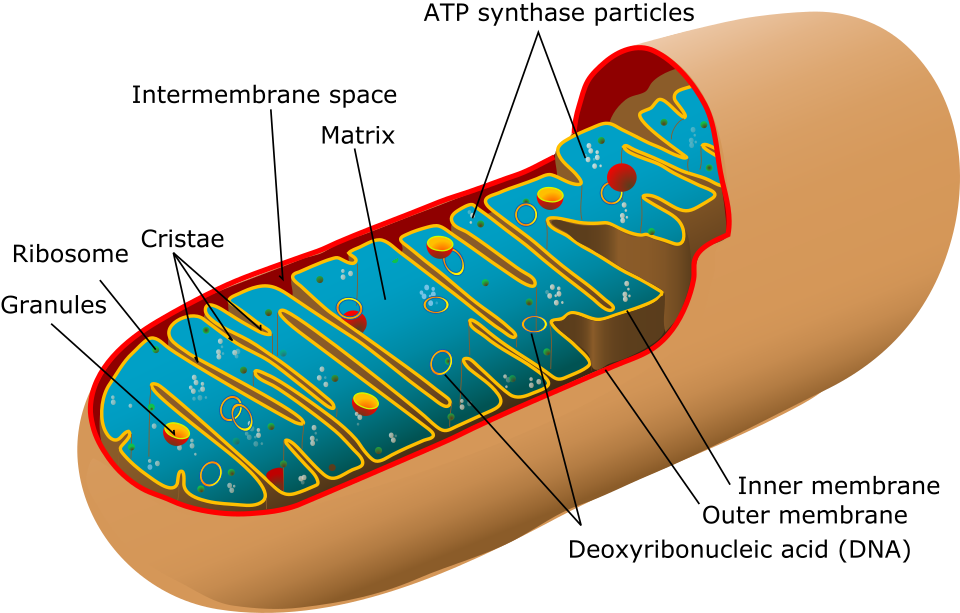
Diagram: Mariana Ruiz Villarreal (LadyofHats), public domain — Wikimedia Commons
Mitochondrial DNA
A tiny, separate loop of DNA inside the mitochondria — just 16,569 letters. Far smaller than the nuclear set, and kept in a different place.
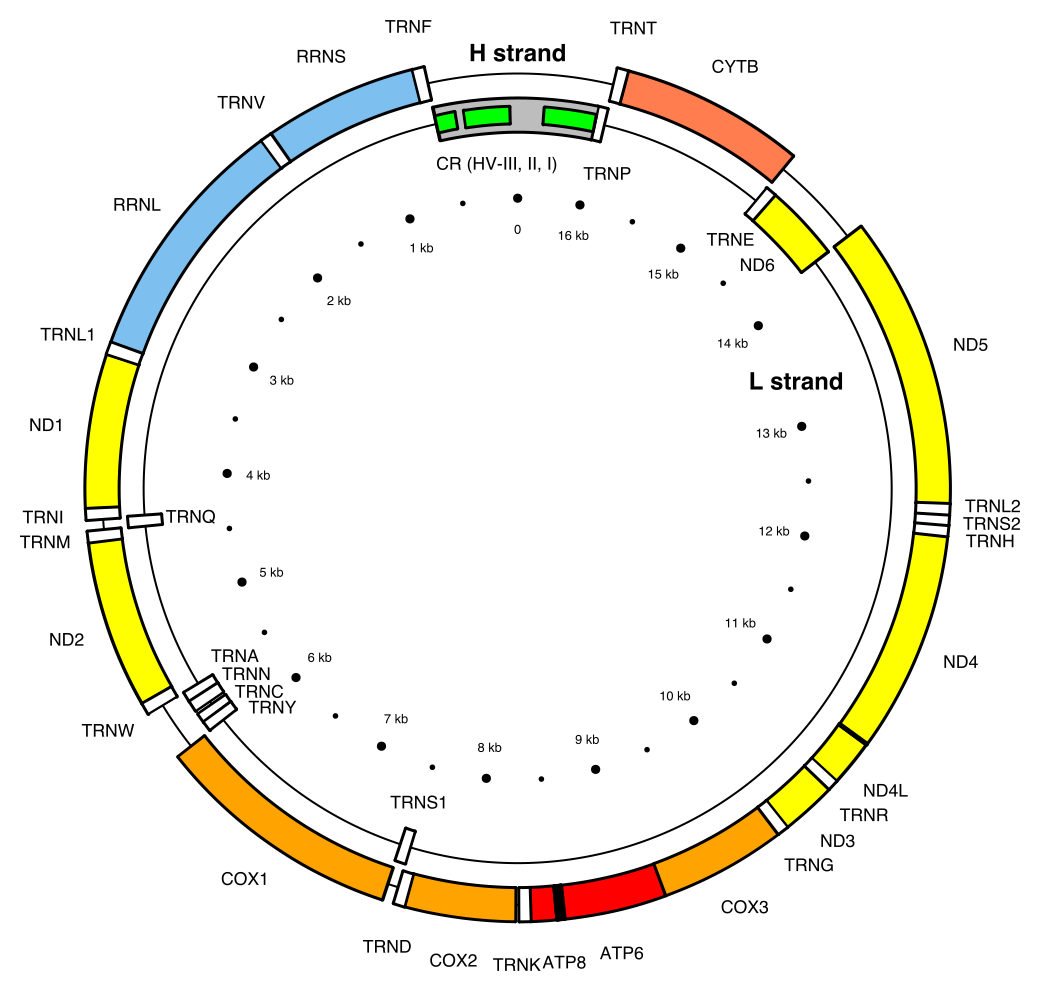
The whole mitochondrial genome is one small circle. Around it you can spot the parts we track — the Complex I genes, COX (Complex IV), CYTB, the rRNAs and tRNAs, and the D-loop control region (the same slices as the O1 wheel).
Diagram: Emmanuel Douzery, CC BY-SA 4.0 (used unmodified) — Wikimedia Commons
Nuclear vs mitochondrial — how big?
letters
letters
The nuclear set is about 200,000× bigger than the mitochondrial loop — the gold sliver is drawn far too big just to be visible.
The story of a fossil
Mutation
A random change to a single DNA letter, passed on when a cell copies itself. Changes pile up slowly over generations. Mitochondrial DNA mutates faster than nuclear DNA — mainly because it sits right next to the cell's energy reactions (a chemically harsh spot) and is copied with less proofreading than the nucleus.
The same stretch copied down the generations. Each step a random letter flips and sticks, so an old copy slowly drifts from the original — and mitochondrial DNA drifts fastest of all.
NUMT say "new-mite"
A scrap of mitochondrial DNA that got copied and pasted into the nuclear DNA long ago, and has been carried in the genome ever since.
It is not a gene — just a stray mitochondrial fragment sitting inside the nuclear set.
▶ Video from the talk: a scrap of mtDNA pasted into the nuclear DNA (Frith Lab)
Genomic fossil
Another name for a NUMT. Like a fossil, it is an ancient copy that slowly wears down over time but stays exactly where it landed.
Alignment
Lining up two stretches of DNA side by side to see how well they match. A strong match means the two pieces are related.
Two copies lined up column by column. Where the letters match, the pieces are related; where they've drifted apart, mismatches show up. This lining-up is how a faded fossil is spotted through a fresher copy.
Shared ancestor (common ancestor)
Two species that look different today can descend from the same ancestor long ago — humans and mice share one, and further back, so do humans and opossums.
This is the key to the whole trick: a fossil that pasted into a shared ancestor is inherited by every descendant, so today it sits at the same spot in each of them.
The gold-and-blue fossil chip pastes into the shared ancestor, then rides down every branch — so each species today carries a copy at the same spot. That's how we can spot a faded human copy by finding the fresher one in another animal.
Diverge — how closely related are two species?
Two species diverge when their lines of descent (their lineages) split off from a shared ancestor and go their own separate ways. The longer ago that split happened, the more distant the two cousins are today.
So a close cousin split from us recently (a chimp, a mouse), and a distant or "old" cousin split from us a very long time ago (an opossum or platypus — over 150 million years back). "Older" means the split is deeper in the past — not that the animal itself is old.
The same splits, now on a timeline. We last shared an ancestor with mouse ~90 My ago, with opossum ~160 My, and with platypus ~180 My — so an older split (further left) means a more distant cousin.
How deep those numbers really are. SLAIN1's fossil (~160 My) dates to the age of the dinosaurs; the gene around it reaches back to the first reptiles (~319 My) — before any dinosaur. Only the ~160 My is claimed for the fossil itself.
Ortholog / cross-species match
The "same spot" in another animal's genome, inherited from a shared ancestor. A fossil pasted into that ancestor sits at the same place in all its descendants — so we can find a faded human NUMT by reading the fresher copy in, say, a mouse.
"Dead" / potential NUMT
A NUMT whose present-day human copy has drifted so far that we can no longer recognise it as mitochondrial on its own.
"Dead" means undetectable, not deleted. The fragment is still sitting there — we just can't read its mitochondrial signal directly.
Conservation depth
How far back through the animal family tree a sequence can still be traced. Deeper down the tree = older and more conserved.
Natural selection — why some DNA changes slowly
Mutations hit all DNA at random. In DNA that does an important job, most changes break something, so the animals carrying them leave fewer descendants and the change dies out — the sequence stays nearly the same for millions of years ("conserved"). DNA with no job is free to change, so it drifts fast.
That's why a fossil still recognisable after ~160 million years was probably being protected — a hint that it matters.
Exon (and what "coding for a protein" means)
An exon is the part of a gene that carries its working message. When a gene is read, the introns are cut out and the exons are joined up to make the final instruction.
Many genes are recipes for proteins — the tiny molecular machines that do most of the work in a cell: they build its structures, carry signals, and run almost every chemical reaction that keeps you alive. To make one, the cell reads a gene's exons in three-letter words, each word naming one building block (an amino acid); strung together and folded up, those blocks become the working protein. A gene read this way is called protein-coding.
That is why landing in an exon — and especially inside a working protein-coding gene, like PTOV1 (the only one of all 189) — stands out: protein-coding DNA is under the most pressure to stay unchanged, because a random change there can break the protein. A fossil sitting in one is the rarest, most interesting case. Still, sitting there is not proof it does a job.
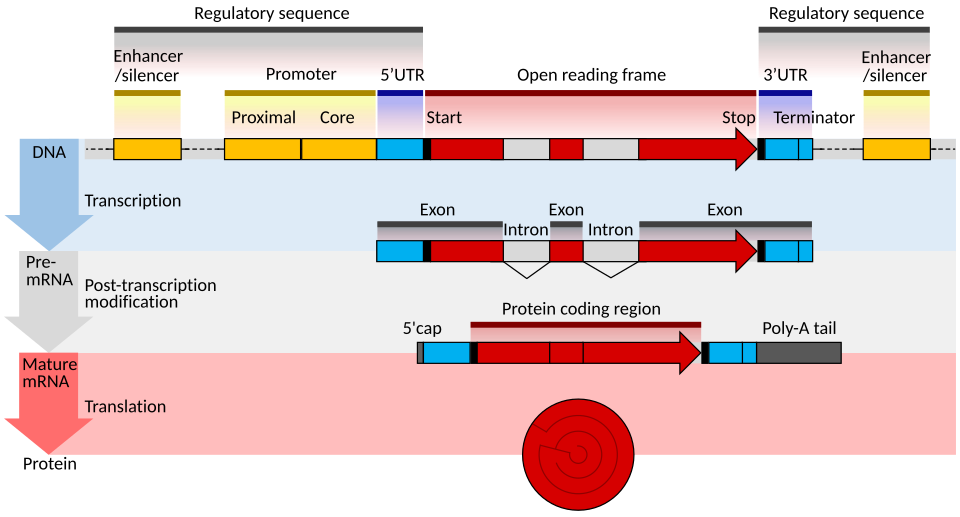
A gene: exons are kept, introns are cut out. Diagram: Thomas Shafee, CC BY 4.0 — Wikimedia Commons
OXPHOS group
The mitochondrial genome comes in functional parts: Complex I, Complex IV, rRNA, tRNA, CYTB, ATP, D-loop. We track which part each fossil originally broke off from. (You can see them marked around the loop under Mitochondrial DNA, above.)
OXPHOS = oxidative phosphorylation, the mitochondria's energy-making machinery. Complex I & Complex IV and CYTB & ATP are parts of that energy chain; rRNA & tRNA are the machinery that builds those proteins; the D-loop is the small control region that doesn't code for anything (which is why it's captured less than its size would predict).
Ancestral reconstruction (ASR)
Rewinding the tape of evolution: using several living relatives to rebuild what their shared ancestor's DNA most likely looked like. Where relatives disagree, we don't guess. (The specific tool we use is called genancestor.)
Several living relatives "vote" for each letter of the ancestor. Where they agree, we restore that letter; where they disagree, we leave an N rather than guess.
Annotation (reference map)
An annotation is a reference map that labels what each stretch of a genome is — a gene, a switch, a spacer. We read each fossil's location and its origin off this standard map, rather than deciding it ourselves.
Picture & video credits
Where these images and videos come from
Diagrams and photos are reused from Wikimedia Commons under their respective licences:
• Animal cell & mitochondrion — LadyofHats (Mariana Ruiz), public domain
• DNA structure — Madprime, CC BY-SA 3.0
• Gene / exons & introns — Thomas Shafee, CC BY 4.0
• Human karyotype — Mikael Häggström & Niels Olson (after NHGRI), public domain
• Human mitochondrial genome map — Emmanuel Douzery, CC BY-SA 4.0 (used unmodified)
• Sloth — Stefan Laube, public domain
• Opossum — Cody Pope, CC BY-SA 2.5
• Platypus — Klaus, CC BY-SA 2.0
• Wood mouse — Rasbak, CC BY-SA 3.0
The hand-drawn diagrams (alignment, mutation, dated family tree, deep-time bar, ancestral reconstruction) and the two videos are the talk's own work (Jayden · Frith Lab).
Where did each fossil come from?
To determine, analyse and evaluate each NUMT's mitochondrial gene of origin — and whether that capture is random.
Revealed once we reach the answer in the talk.
From all over the mitochondrial genome — but captured mostly in proportion to size. The bigger a part of the mitochondria is, the more often a fossil comes from it. Capture looks random and size-driven, not the cell choosing.
Try it — spin the mitochondria
Each slice is sized to how often we found fossils from that part. Spin a few times and your tally takes the same shape as what we actually found — the biggest parts are captured most.
Questions about this
Is the capture really random?
Mostly. Bigger parts of the mitochondria get captured more often simply because they're bigger targets — that's what the wheel shows. It is mostly length-proportional, with one small documented bias (the D-loop is under-represented). No one is choosing which piece to keep.
What are the seven slices (OXPHOS groups)?
The mitochondrial genome comes in functional parts — Complex I, Complex IV, rRNA, tRNA, CYTB, ATP, D-loop. Each fossil originally broke off from one of them, and that's what we trace. Complex I/IV, CYTB and ATP build the energy chain; rRNA and tRNA are the machinery that makes those proteins; the D-loop is a small control region that codes for nothing — which is why it's captured less than its size predicts (see OXPHOS group in Basics).
Does where it came from decide what it does?
No — those are two separate questions. Where a fossil came from (its mitochondrial origin, this page) is independent of where it landed in our genome (its function, the next page).
Where did each fossil land — and does it matter?
To annotate, analyse and evaluate the nuclear-locus functional potential of all 189 ancient human NUMTs (hg38), with a closer look at the standout fossils.
Revealed once we reach the answer in the talk.
A fossil drops in at random, so you'd expect it to land in junk — the spacer DNA between and inside genes. Most do. But a striking share of ours sit in DNA that does something: control switches, active regions, exons — and one (PTOV1) inside a working gene. Same picture whether found directly or via other animals, so it's real, not a quirk of the method.
Why the tilt? Our 189 are only the ancient survivors — the fossils that mutated the least over millions of years — and slow-changing DNA is usually DNA that matters.
This hints some were repurposed; it doesn't prove it. Knowing where a fossil landed is not the same as proving it does a job there.
Only about 1–2% of your DNA actually spells out proteins — that's "coding" DNA. The rest is "non-coding": some of it works as switches and spacers, some is quiet. Here is where the 189 landed, and what each place means:
What each category means
Inside a gene, non-coding 73
Landed inside a gene, but in an intron — a spacer stretch that's copied out and then thrown away before the protein is made. Very common, and usually harmless.
Active / regulatory DNA 65
Landed in DNA that acts like a switch or dial, helping control when nearby genes turn on. It isn't a protein itself, but it can still matter.
Quiet / near a gene 32
Sitting close to genes but in regions with no obvious job — the "quiet" parts of the genome.
In a gene's message (exon) 18
Landed in an exon — a piece of a gene that is kept and read out to help make the product. Notable, but landing there still isn't proof it does anything.
In a working protein-coding gene 1
The single fossil — PTOV1 — that landed right inside a working, protein-coding gene. The rarest spot of all: 1 out of 189.
The standout fossils
PTOV1 — the 1 that landed in a working gene
The one fossil of all 189 that landed inside a working, protein-coding gene — the rarest spot. Its mitochondrial origin traces to sloth ND5; found only in placental mammals — the group that grows its young in a womb, like humans, mice and sloths (~99 My).
The cancer link people cite is about the host gene PTOV1 — not the fossil. And landing there isn't proof the fossil does a job.
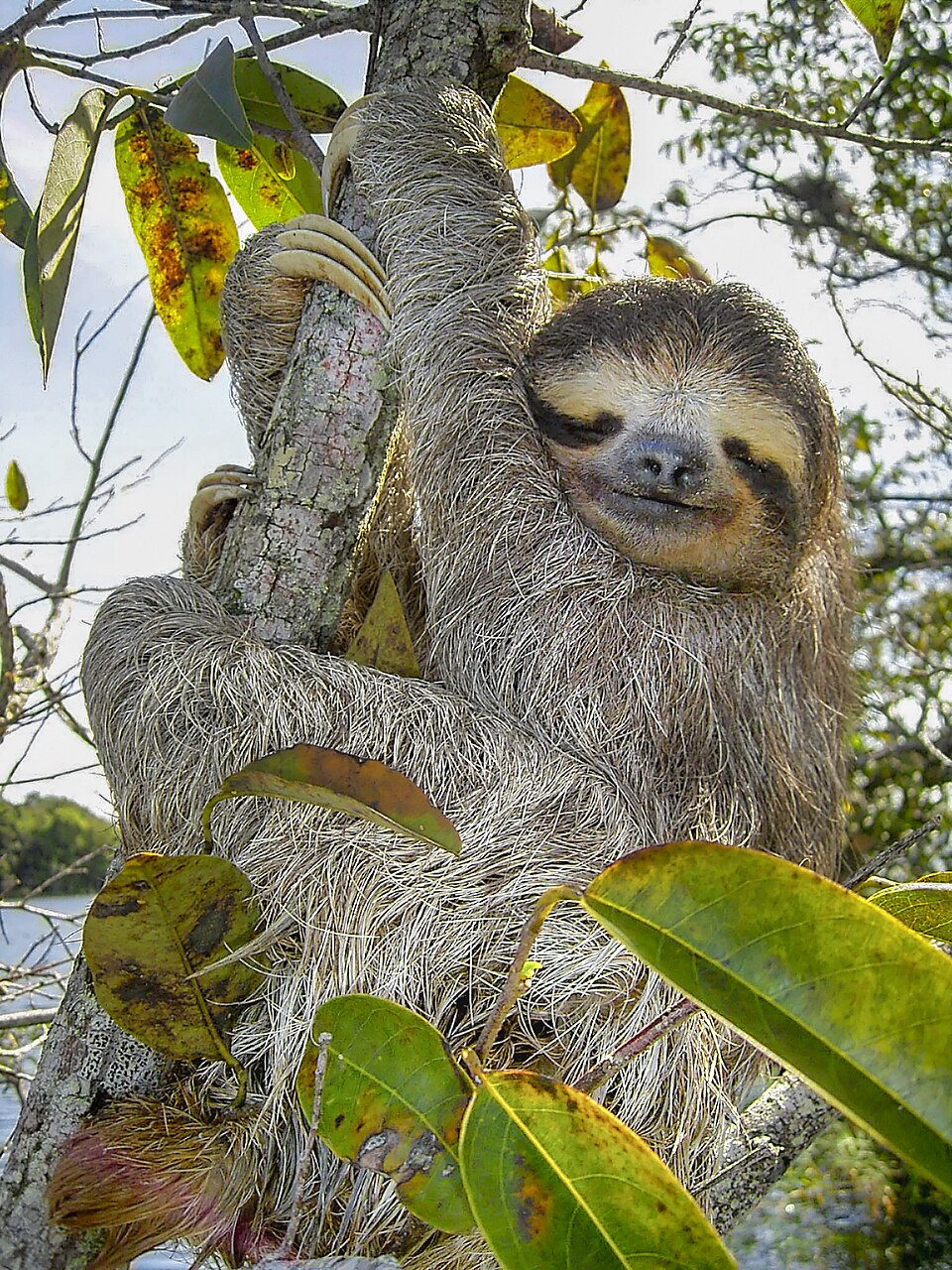
Its mitochondrial origin traces to the sloth. Photo: Stefan Laube, public domain — Wikimedia Commons
SLAIN1 — the exon fossil we rewind
Landed in a gene's message (an exon), in an unusually ancient spot. Its mitochondrial origin traces to mouse COX2. Its human copy looks dead, but rewinding the ancestor recovers a family resemblance in opossum and platypus — distant mammal cousins we split from ~160 My ago — eroded, not vanished. That reconstruction is Objective 3, coming up in the talk.
The fossil is ~160 My old; the gene around it is older (traces to reptiles, ~319 My). Two different ages — we only claim ~160 My for the fossil.
Questions about this
What's the difference between "coding" and "non-coding"?
Coding DNA spells out a protein — the cell's working machines. Non-coding DNA doesn't spell a protein, but it can still do jobs like switching genes on and off. Only ~1–2% of your genome is coding.
Does landing in a gene mean the fossil has a function?
No. We can say where each fossil landed, but co-location is not proof of a job. That's a fence we keep: where it landed ≠ what it does.
How many fossils are there, and do any of them do something?
189 ancient NUMTs. Exactly one (PTOV1) landed inside a working protein-coding gene; the rest land in non-coding, regulatory, or near-gene DNA.
Can we bring a faded one back?
To test whether ancestral reconstruction can recover a NUMT's ancestral signal that is undetectable in the present-day human genome.
Revealed once we reach the answer in the talk.
Yes — for SLAIN1 we recovered a computational family resemblance: rebuild the ancestor and the faded fossil lines up again with the copies in opossum and platypus. So it eroded rather than vanished.
This is a nuclear, cross-species resemblance. It does not show the copy still works as mitochondrial DNA — that separate test came back negative.
This is the live centrepiece of the talk — watch the main screen for it. Below are the honest answers to what the reconstruction does, and doesn't, show.
Questions about this
What do "distant" or "oldest" cousins mean here?
Opossum (a marsupial — a pouched mammal) and platypus (a monotreme — an egg-laying mammal) are some of our most distant mammal cousins. We last shared an ancestor with the opossum about 160 million years ago, and with the platypus even further back (~180 My). So recovering SLAIN1's family resemblance in them means the fossil's signal reaches that far back in time.
"Oldest cousin" just means the split happened the longest ago — see Diverge in the Basics tab.
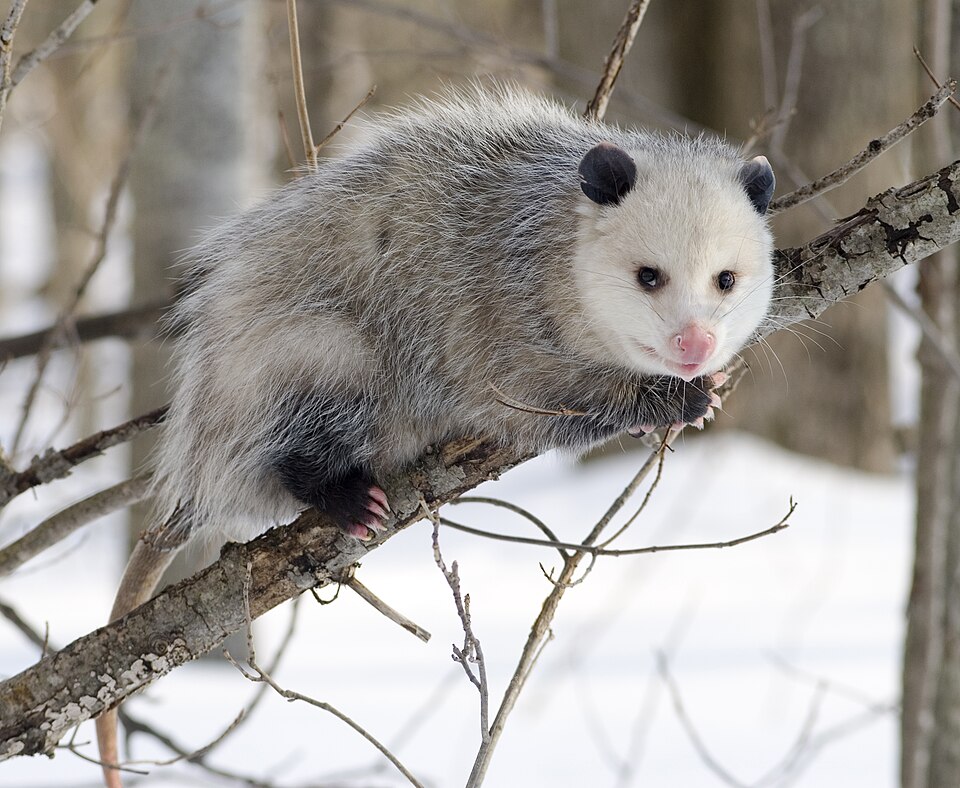
Opossum — a marsupial cousin (~160 My). Photo: Cody Pope, CC BY-SA 2.5 — Wikimedia Commons
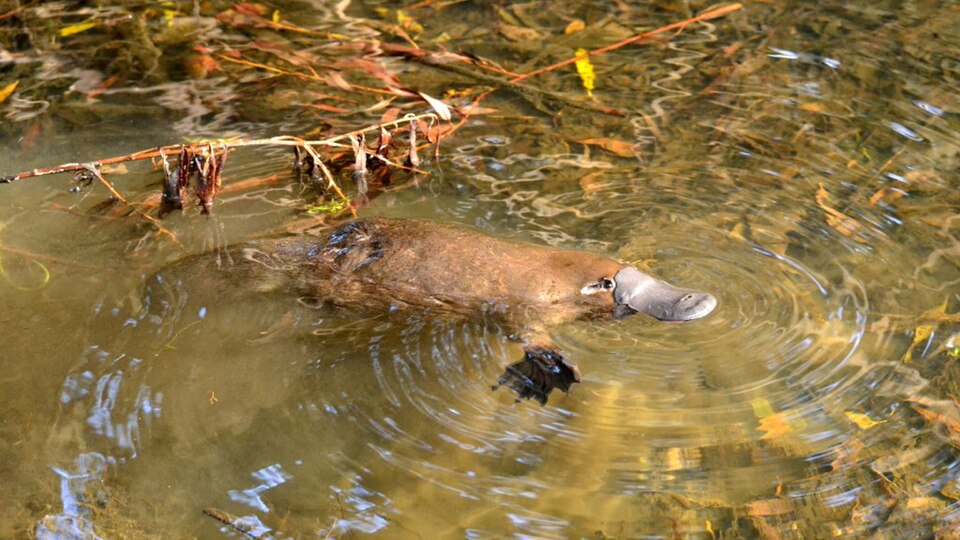
Platypus — an even more distant cousin (~180 My). Photo: Klaus, CC BY-SA 2.0 — Wikimedia Commons
Did you actually bring a fossil back to life?
Not literally — "resurrect" is the hook. What we recovered is a computational family resemblance: by reconstructing the ancestor, SLAIN1's faded sequence lines up again with the copies in opossum and platypus.
That shows the fossil eroded rather than being deleted. It does not show the copy still works as mitochondrial DNA.
So is it still mitochondrial?
We didn't show that — that specific test came back negative. The recovery is a nuclear, cross-species resemblance. Whether the copy still reads as mitochondrial is the next question, not something we've proven.
Why elephant and rabbit on the screen?
They're extra relatives whose copies changed slowly, so they still show close to the ancestral sequence. Where independent relatives agree on a letter, that letter was almost certainly in the shared ancestor — so genancestor uses their agreement as evidence to restore the mouse's ancestral base.
They are the "vote", not the answer.
What does "1 in 10 billion" mean?
It's how unlikely the recovered match is to be a fluke. After rebuilding the ancestor, SLAIN1 lines up with the opossum copy so well that you'd expect a match that good by pure chance only about once in ten billion tries — strong evidence the resemblance is real, not coincidence.
Why use a mouse to study a human fossil?
The fossil was pasted into the shared ancestor of mouse and human, so both carry it at the same spot — and it was detected directly in the mouse (mouse nuclear DNA matched to a mouse mitochondrial protein). But mice evolve fast, so the modern mouse copy has drifted so far it no longer lines up with our oldest cousins.
That is exactly why we rewind it: reconstruct the mouse's ancestor and the match reappears.
SLAIN1's ~160-million-year age itself comes from the human side of the alignment.
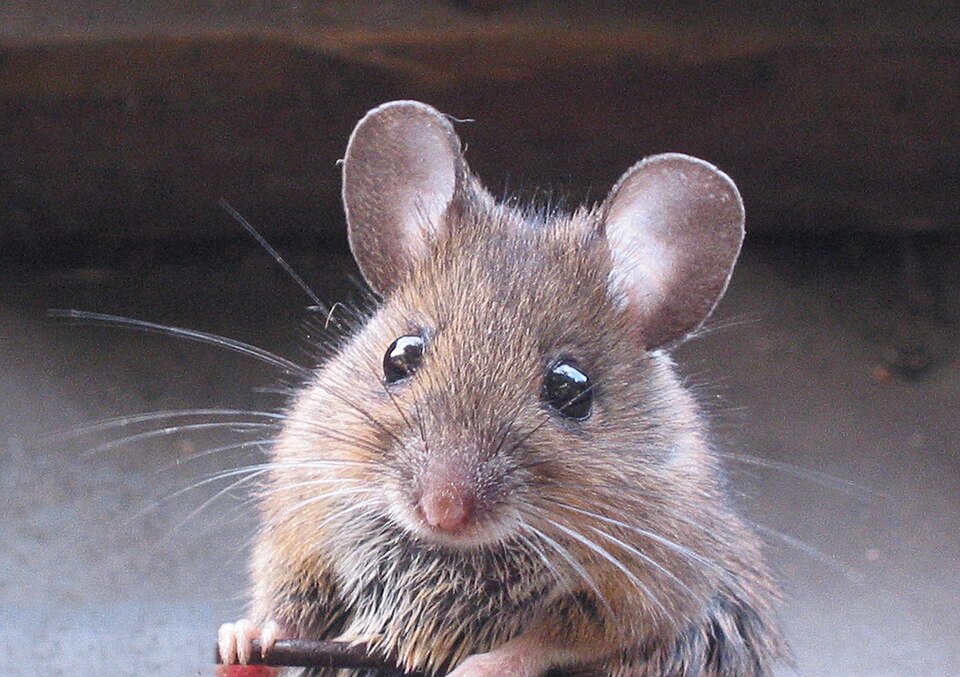
Photo: Rasbak, CC BY-SA 3.0 — Wikimedia Commons
Could reconstruction find brand-new fossils?
Maybe — that's future work. An age-matched ancestral mitochondrial genome flagged about 74 candidate spots the modern mitochondria miss.
Those are unverified leads, not confirmed NUMTs.
Ask a question
Got a question during the talk? Type it here and send it to the presenter — no need to wait for the mic. Your questions may appear on the presenter's screen for the Q&A.
Your questions